AI Agent vs Chatbot: What Should a Business Choose?
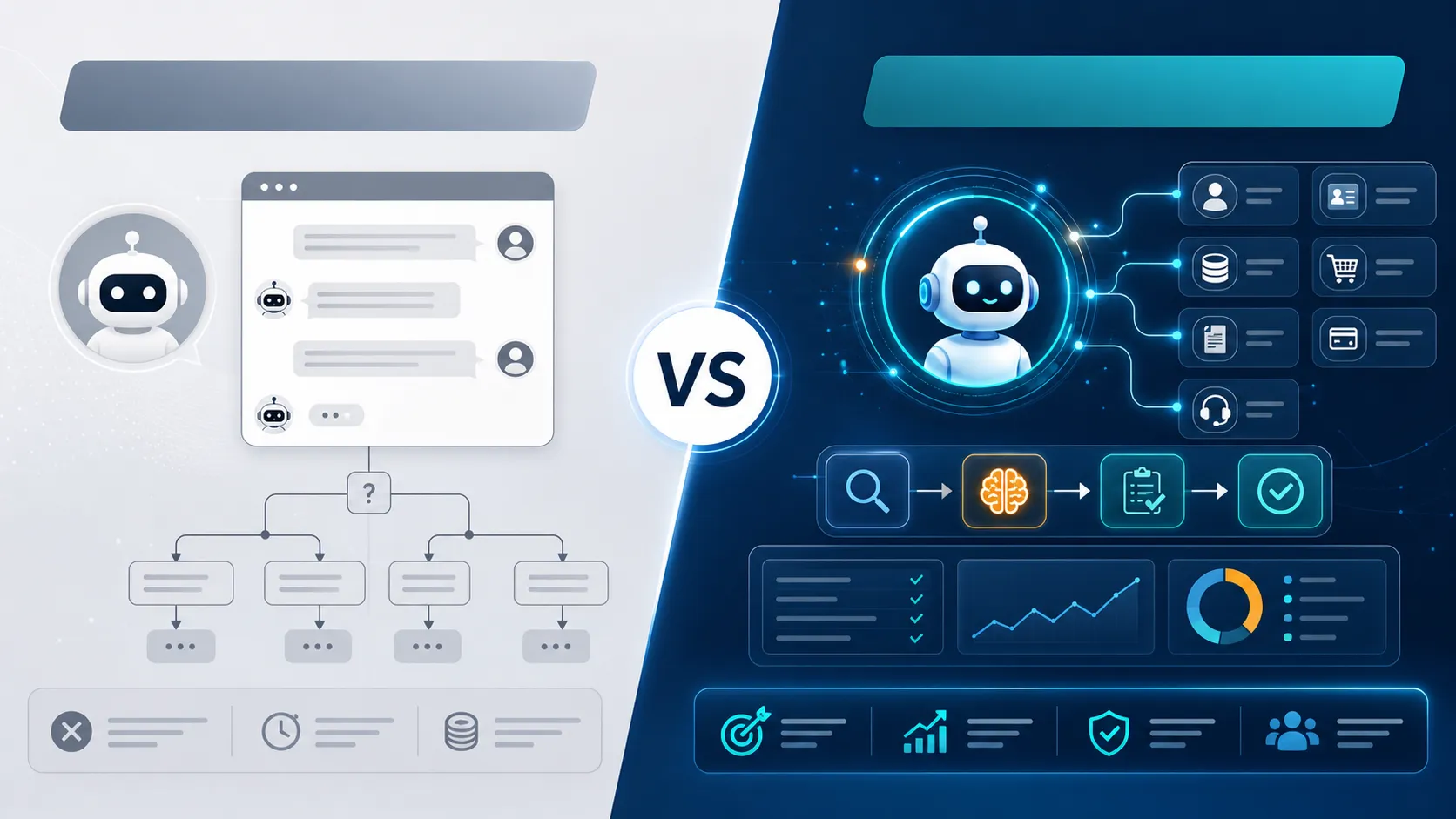

"AI agent" and "chatbot" get used interchangeably in sales conversations and online content, but they're not the same tool, and picking the wrong one for your situation either overspends on capability you don't need or underdelivers on what your customers actually expect. Here's the real difference, and how to decide which one fits your business.
A chatbot answers from a script: pre-written responses, decision trees, or FAQ matching. An AI agent reasons about a request, retrieves real data from your connected systems, often through something like an MCP server, and can take real action, not just respond with text. They solve different problems, and plenty of businesses genuinely only need the simpler one.
| Chatbot | AI Agent | |
|---|---|---|
| What it does | Answers FAQs and routes to help content | Looks up real data and resolves multi-step requests |
| Where answers come from | Scripted responses or a decision tree | Connected business systems (CRM, order database, etc.) |
| Can it take action | Rarely, mostly informational | Yes, within permissions you define |
| Setup complexity | Lower, often days to launch | Higher, requires real system integration |
| Best for | High-volume, low-complexity FAQ-style support | Order or account-specific requests and internal workflows |
If most of your support volume is repeat questions, "what are your hours," "where's your store," "what's your return policy," a chatbot answers those correctly and costs far less to build and run than an agent. Don't over-engineer this: see our piece on what an AI agent for customer support actually does for a clearer picture of when the extra capability is worth paying for.
Once customers are asking questions that require looking something up, "where's my order," "can I return this," "what's my account balance," a chatbot hits a wall: it either can't answer or sends the customer to a human. That's the point where an AI agent, connected to the systems that hold those answers, starts paying for itself.
A chatbot is close to off-the-shelf: minimal setup, predictable cost. An AI agent requires real integration work, defining what it can access and do, testing it against edge cases, deciding cloud vs on-premise for the data it touches. That's not a reason to avoid it, it's a reason to scope it narrowly at first rather than trying to automate everything on day one.
Ask: does answering this question require looking at something specific to this customer? If the answer is the same for everyone, a chatbot is fine. If the answer depends on that specific customer's order, account, or data, you need an agent.
Not exactly, it's a different category of tool. A chatbot answers from scripts; an agent connects to real systems and can look up and act on actual customer data, which is what justifies the added cost and complexity for the right use case.
Not by upgrading the existing tool itself, an agent is built around a connection to your business systems from the ground up, but you can start with a chatbot and add agent capabilities for specific high-value use cases as you grow.
Many businesses end up running both: a chatbot for general FAQs and a connected agent for account or order-specific requests, handing off between the two as needed.
If a meaningful share of your tickets require looking up customer-specific data, order status, account details, that's a strong signal an agent will pay for itself faster than scaling your support team alone.
Get a free AI audit and we'll tell you honestly, chatbot, agent, or both.
Get Free AI Audit