Manual Workflows That SMEs Should Automate First
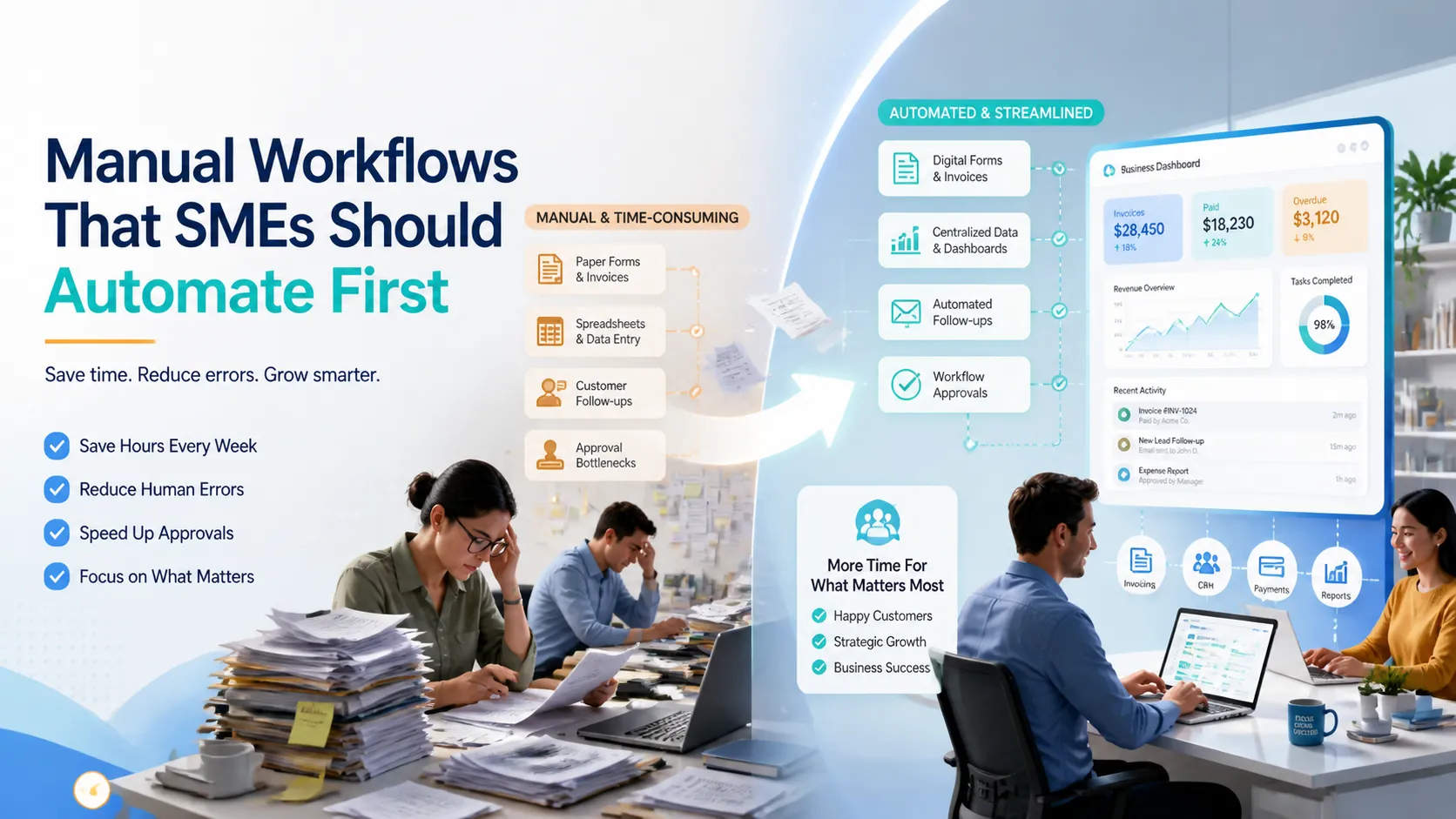

Not every manual process in your business needs to be automated, and trying to fix everything at once is usually how automation projects stall before they finish. The businesses that get real value out of automation tend to start narrow: one repetitive, high-volume, rule-based workflow, get it working cleanly, then move to the next. Here's where that first project usually pays off fastest for a small or mid-sized business.
Prioritize tasks that are repetitive, high in volume, and rule-based, the ones with a clear input and a predictable output, rather than anything that still requires judgment calls or changes shape every time someone does it. Those are the workflows where automation has the least risk and the fastest payback.
| Factor | What to ask |
|---|---|
| Frequency | How often does this task happen, daily, weekly, monthly? |
| Time per task | How many minutes does one instance actually take someone to do? |
| Error cost | What happens when this is done late or done wrong, a missed payment, a lost lead, a stockout? |
Multiply frequency by time per task to estimate the hours it's costing your team each month, then weigh that against how painful a mistake in that process actually is. The workflow with the highest combined score is almost always your right starting point, not necessarily the one that feels most urgent today.
Avoid starting with anything that still requires real judgment, a process that's actively changing as your business grows, or a workflow that only happens a handful of times a month. These either don't save enough time to justify the build, or they'll need to be rebuilt again soon after you finish, which burns goodwill on automation before it's had a chance to prove itself.
List every recurring manual task your team does in a typical week. For each one, note roughly how long it takes and how often it happens. The task at the top of that list, by total hours spent per month, is almost always the right place to start, because it's the one where automation will be most visibly felt across the business.
No. Starting with one high-volume, rule-based workflow and getting it working cleanly before expanding tends to produce better results than trying to automate multiple processes simultaneously.
Lead capture and follow-up is usually the fastest win for most SMEs, since it's high-frequency, rule-based, and directly tied to revenue.
Multiply how often the task happens by how long each instance takes. If that adds up to several hours a month and the process is repetitive and rule-based, it's a strong automation candidate.
Yes, anything that still requires real judgment calls, or that only happens a few times a month, usually isn't worth automating first since the time saved doesn't justify the build effort yet.
Get a free AI audit and we'll help you find the highest-leverage starting point for your business.
Get Free AI Audit