Common E-commerce Backend Mistakes
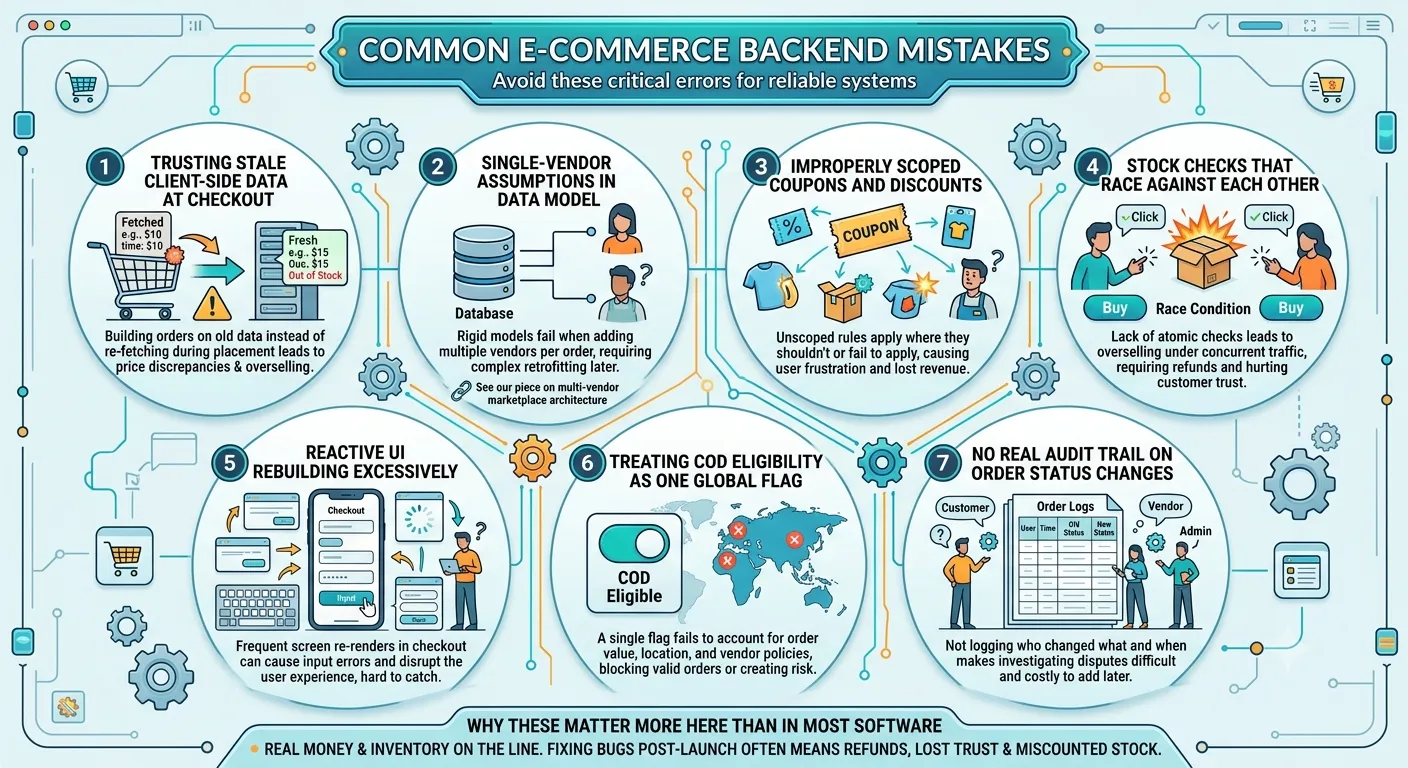

Most e-commerce backend problems don't show up in development. They show up later, during a sale spike, at the exact moment a customer is entering payment details, or when two people try to buy the last unit of something at once, because the conditions that trigger these bugs only really appear under real concurrent usage. Here are the mistakes we see cause the most damage, and the most customer trust, when they slip through.
The highest-impact mistakes almost always involve trusting stale data, assuming single-vendor logic in a system that will eventually support multiple vendors, and skipping atomic checks on anything involving stock or payment. None of these are exotic bugs, they're ordinary oversights that only become expensive once real money and real customers are involved.
Building the final order from data that was fetched when the customer opened their cart, rather than re-fetching fresh price, stock, and discount data the moment the order is actually placed, is one of the most common sources of disputed orders: a customer checks out for an item that went out of stock or changed price minutes earlier, and the order goes through anyway.
Storing a single vendor reference per order, instead of designing for multiple vendors per order from the start, works fine until you actually onboard a second seller and an order legitimately needs to span vendors. Retrofitting multi-vendor support onto a single-vendor data model is a significantly bigger job than building it in from day one, see our piece on multi-vendor marketplace architecture for what that actually involves.
A discount rule written without explicitly enforcing which vendor, product, or category it applies to tends to either apply everywhere it shouldn't, or nowhere it should, the moment more than one vendor starts selling similar products. Scoping needs to be explicit in the logic, not assumed from context.
Two customers buying the last unit of something at the same moment, without a proper atomic check-and-decrement step on the backend, results in overselling: both orders go through, and now someone has to be refunded or disappointed after the fact. This is invisible in single-user testing and only appears under real concurrent traffic.
In checkout flows especially, listening to a live data stream that re-renders the entire screen on every minor update can cause subtle, hard-to-reproduce bugs, a dismissed keyboard, lost form input, right at the point a customer is entering payment details. These bugs are notoriously hard to catch in QA because they depend on exact timing.
Real cash-on-delivery eligibility usually depends on order value, delivery location, vendor policy, and sometimes customer history together, not a single global on or off switch. Treating it as one flag either blocks legitimate orders or accepts ones that shouldn't qualify, both of which cost money in different ways.
When an order's status can be changed from the customer app, the vendor panel, and the admin panel, not logging who changed what and when makes a disputed order nearly impossible to investigate properly later. This is cheap to build in early and genuinely painful to add after the fact.
Real money and real inventory are on the line. Fixing a bug after launch in e-commerce often means processing refunds, losing customer trust, or sitting on stock that's already been miscounted, not just shipping a patch and moving on.
Test under concurrent load specifically, not just clean single-user flows, and run real multi-vendor order scenarios through checkout, not just single-vendor carts, before assuming the system is ready for real traffic.
Most of them depend on real concurrent usage, multiple people checking out at the same time, which is difficult to reproduce in single-user development testing and usually only surfaces under genuine traffic.
Overselling from unguarded stock checks tends to be the costliest, since it directly results in refunds, cancellations, and damaged customer trust, often during the highest-traffic moments like a sale.
Most of them, yes, they're typically fixable with targeted changes to the affected logic rather than a full rebuild, but multi-vendor data model issues specifically tend to require more substantial rework.
Simulate multiple simultaneous orders against the same limited-stock item and the same coupon code, rather than only testing one order at a time, to surface race conditions before real customers do.
Get a free AI audit and we'll review your backend before it costs you a real order.
Get Free AI Audit