RAG vs Fine-Tuning for Business AI Apps
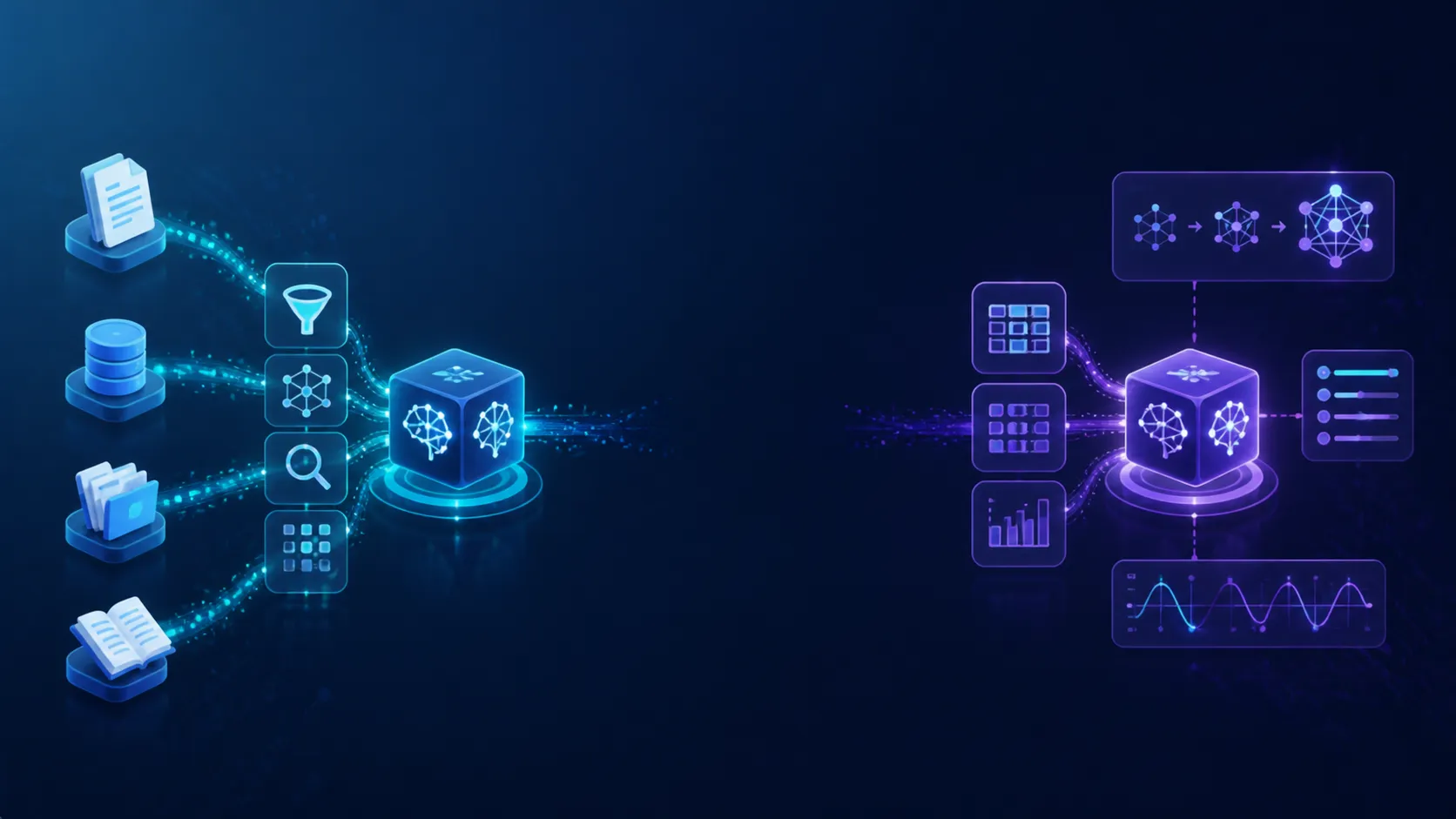

Once a business decides it wants an AI system that actually knows its own data, products, policies, internal documents, the next question is how to get there. Two approaches come up constantly: RAG and fine-tuning. They get conflated in a lot of sales conversations and content, but they solve genuinely different problems, and picking the wrong one wastes both budget and time.
RAG, retrieval-augmented generation, keeps the underlying AI model exactly as it is and feeds it relevant information at the moment of each request, pulled fresh from your own data. Fine-tuning actually retrains the model's weights on your data, so the behavior or knowledge becomes baked directly into the model itself. Most business use cases are better served by RAG. Fine-tuning is the more specialized, more expensive choice, and it's worth understanding when it's actually the right one.
At the moment a question comes in, the system retrieves the most relevant chunks of your own data, documents, product details, policies, and includes them directly in what's sent to the model, so the answer is grounded in current, real information rather than whatever the model happened to memorize during its original training. This is conceptually close to what we cover in our guide on what an MCP server is, both are ways of giving a model access to information it wasn't born knowing.
Fine-tuning trains the model further on a custom dataset so its actual behavior changes, useful for teaching a specific tone, response format, or specialized reasoning pattern that's hard to achieve reliably through prompting alone. It's less about teaching the model new facts and more about reshaping how it responds.
| RAG | Fine-Tuning | |
|---|---|---|
| Best for | Facts and data that change often | Consistent tone, format, or behavior |
| Updating information | Update the data source, done | Requires retraining |
| Cost to set up | Lower | Higher |
| Transparency | Can show which source informed the answer | Harder to trace why the model answered a certain way |
| Typical timeline | Days to weeks | Weeks, plus an ongoing retraining cycle |
Most business data, prices, stock levels, policies, account details, changes constantly. RAG always pulls the current version at query time. Fine-tuning bakes in a snapshot of whatever the data looked like when it was trained, which starts going stale the moment anything changes. RAG is also dramatically cheaper and faster to set up and update, and it's more transparent, you can usually see exactly which source informed a given answer, which matters both for trust and for catching mistakes.
Yes, and it's a common combined approach: fine-tune for tone and behavior, then use RAG to keep the model grounded in current, accurate data. The two aren't mutually exclusive, they solve different layers of the same problem.
Ask whether the AI needs to know something or behave a certain way. If the answer is "know something," start with RAG. If it's "respond in a specific, consistent way regardless of the topic," consider fine-tuning, usually alongside RAG rather than instead of it.
Generally yes, both to set up initially and to maintain over time, since updating a RAG system means updating the underlying data rather than retraining the model itself.
Yes, they're not mutually exclusive. Many businesses start with RAG to validate the use case, then add fine-tuning later for specific tone or behavior needs once those become clear.
Not in the way most people expect. It changes how the model behaves more than what it knows, for actual business knowledge that changes over time, RAG is usually the better fit.
Both are ways of giving a model access to information beyond its original training, RAG retrieves relevant data for a given query, while an MCP server defines what systems and actions a model can connect to more broadly.
Get a free AI audit and we'll give you a straight, honest recommendation.
Get Free AI Audit